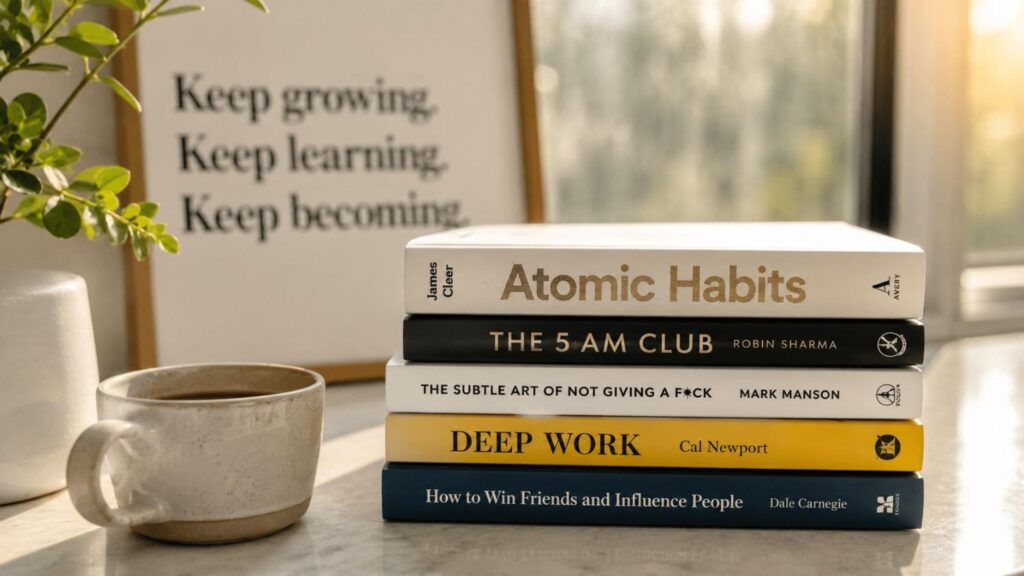
Top 5 Books on Self-Improvement You Need to Read
The top 5 books on self-improvement you need to read should do more than create a temporary feeling of motivation. A worthwhile personal-development book helps you understand a meaningful problem, gives you a framework for thinking about it, and suggests actions you can evaluate in real life.
This standard matters because self-improvement covers several distinct areas. A person may have clear goals but struggle to repeat the daily behaviors that support them. Another reader may interpret mistakes as evidence that they lack talent. A professional may understand what matters but remain trapped in constant messages, meetings, and shallow tasks.
Other readers are not trying to become more productive at all. They may be reflecting on identity, purpose, responsibility, grief, uncertainty, or the direction of their lives. A complete reading list must leave room for these deeper questions.
The five recommendations in this guide were selected to address different dimensions of development. Atomic Habits explains how systems, environment, and repeated actions shape behavior. Mindset examines beliefs about ability, learning, and failure. The 7 Habits of Highly Effective People connects personal responsibility with priorities, communication, and cooperation.
Deep Work focuses on sustained concentration in environments full of interruption. Man’s Search for Meaning combines historical testimony with a meaning-centered view of human responsibility and suffering.
These titles should not be treated as unquestionable authorities. Every personal-development framework reflects particular assumptions, examples, and cultural contexts. Readers should compare ideas with evidence, experience, values, and professional guidance.
In my experience, the most effective approach is to read one book at a time, extract one important principle, and turn it into a specific experiment. The aim is not to finish the longest reading list. It is to create a thoughtful change that survives after the book has been returned to the shelf.
Related Articles
How These Five Self-Improvement Books Were Selected
A useful list of the best self-improvement books should cover several areas of development instead of presenting five books that repeat the same productivity principles. This list was designed around habits, mindset, effectiveness, focus, and meaning.
Each recommendation needed a distinctive central contribution. Readers should be able to explain why the book belongs on the list and identify the problem it is best suited to address.
Practical value was another important requirement. A book did not need to provide a rigid step-by-step program, but it needed to offer ideas that could influence behavior, reflection, priorities, or decision-making. A title that creates temporary enthusiasm without helping a reader think or act differently provides limited long-term value.
The list also balances immediate application with deeper reflection. Atomic Habits offers highly practical behavior-design techniques. Mindset changes the way readers may interpret learning and setbacks. Covey provides a broad principle-centered framework, while Newport focuses specifically on concentration. Frankl’s work asks readers to consider meaning and responsibility under difficult circumstances.
Popularity was considered, but bestseller status was not treated as proof of universal value. A widely read book may still be unsuitable for a particular reader, while an older book may contain ideas that remain useful across changing work environments.
The comparison table helps readers identify the book most closely aligned with their current needs.
| Book | Author | Primary Focus | Best For | Practical Starting Action |
|---|---|---|---|---|
| Atomic Habits | James Clear | Habit formation and systems | Readers struggling with consistency | Redesign one small daily habit |
| Mindset | Carol S. Dweck | Beliefs about learning and ability | Readers discouraged by setbacks | Reframe one failure as feedback |
| The 7 Habits of Highly Effective People | Stephen R. Covey | Principles, priorities, and relationships | Leaders and professionals | Define one meaningful priority |
| Deep Work | Cal Newport | Concentration and valuable output | Students and knowledge workers | Schedule one distraction-free block |
| Man’s Search for Meaning | Viktor E. Frankl | Meaning, purpose, and resilience | Reflective readers facing uncertainty | Write about one present responsibility |
Selection Criteria for a Balanced Reading List
The first selection criterion was distinct usefulness. Each title needed to address a recognizable challenge and offer a framework that remained understandable after the reader finished the book.
The second criterion was range. Personal development is not limited to improving routines or completing more tasks. A balanced list also needs to address beliefs, relationships, values, concentration, and meaning.
The third criterion was practical transfer. Readers should be able to convert at least one major idea into an observable action, reflection practice, conversation, environmental change, or scheduling decision.
Credible source information was also important. The descriptions in this article rely on official author, publisher, institutional, and educational sources when explaining the books and their main frameworks.
Accessibility was considered alongside depth. Atomic Habits is direct and highly actionable, while Man’s Search for Meaning is historically and emotionally demanding. The variety allows readers to choose according to their current capacity and purpose.
Longevity was another useful signal, although age alone does not establish quality. Covey and Frankl continue to be read because their work addresses broad human questions rather than one temporary technology or trend.
No title was selected because it offers a guaranteed solution. The strongest personal-development books provide tools and perspectives. Readers remain responsible for testing, adapting, questioning, and applying those ideas appropriately.
| Personal Goal | Recommended Book | Main Skill Developed | Best Outcome |
|---|---|---|---|
| Build consistent daily habits | Atomic Habits | Habit formation | Better routines and long-term consistency |
| Develop a growth mindset | Mindset | Learning and resilience | Improved confidence when facing challenges |
| Improve leadership and decision-making | The 7 Habits of Highly Effective People | Personal effectiveness | Better priorities and stronger relationships |
| Increase focus and productivity | Deep Work | Concentration | Higher-quality work with fewer distractions |
| Find meaning and purpose | Man’s Search for Meaning | Purpose and resilience | Greater clarity during life challenges |
How to Choose Which Book to Read First
Choose your first book by identifying the problem you are prepared to work on now. Do not select a title simply because it is the most famous or because someone else described it as life-changing.
Begin with Atomic Habits when your main challenge is consistency. You may already understand the desired outcome but struggle to make the supporting behavior easy, visible, or repeatable.
Choose Mindset when fear of failure, perfectionism, self-labeling, or beliefs about natural talent prevent you from attempting difficult work or responding constructively to feedback.
Read The 7 Habits of Highly Effective People when you need a broader personal operating system. It may be especially useful when priorities, relationships, communication, and responsibility feel disconnected.
Select Deep Work when you repeatedly reach the end of a busy day without completing the task that required your best thinking. It is particularly relevant when interruptions and task switching dominate your schedule.
Approach Man’s Search for Meaning when you are prepared for a serious and emotionally demanding exploration of meaning, suffering, responsibility, and dignity.
Avoid beginning all five at once. Read one title, write a brief summary in your own words, and select one practice to test. Review the results before adding another framework.
The goal is not accumulating advice. It is building enough attention and consistency to discover which ideas genuinely improve your decisions or behavior.
If you want to explore more titles after completing these recommendations, browse personal improvement books for additional reading across habits, productivity, leadership, and mindset.
1. Atomic Habits by James Clear
Atomic Habits is a practical starting point for readers who repeatedly set meaningful goals but struggle to maintain the daily behaviors required to support them. James Clear treats habit change as a problem involving systems, cues, environment, repetition, and reward—not simply motivation.
The book’s appeal lies in its manageable scale. Readers are not asked to redesign their entire lives immediately. Instead, they learn to reduce friction around useful behaviors and increase friction around unwanted ones.
The title’s use of “atomic” refers to very small units of change. A small behavior may appear insignificant on one day but become meaningful when repeated consistently and connected with a broader system.
For example, a person who wants to exercise regularly could begin by preparing clothes the night before, placing shoes near the door, and committing to a short walk at a fixed time. The initial objective is reducing the effort required to begin.
The book is particularly strong when readers apply its principles to a concrete routine. It is less useful when consumed only as motivational content.
One important limitation is that environmental design cannot solve every behavior problem. Health conditions, stress, financial limitations, disability, caregiving responsibilities, workplace expectations, and mental-health concerns may require additional support.
Used thoughtfully, however, Atomic Habits provides a clear language for diagnosing why a repeated behavior is easy, difficult, visible, satisfying, or avoidable.
What You Will Learn From Atomic Habits
The book organizes habit formation around a four-part process involving a cue, craving, response, and reward. Clear then presents four corresponding laws for encouraging a useful habit: make it obvious, attractive, easy, and satisfying.
Another important concept is identity-based behavior. Instead of focusing only on an outcome such as finishing twenty books, a reader considers the identity represented by the repeated action: becoming a person who reads consistently and thoughtfully.
The book also explains why environmental design matters. A visible book on a desk may encourage reading more reliably than a vague intention. Removing distracting applications from the home screen may reduce automatic use more effectively than repeatedly demanding stronger willpower.
Habit stacking is another practical technique. A new behavior is attached to an existing routine, such as reviewing tomorrow’s priorities after closing the workday.
Readers also learn to recover after interruptions. Missing one day does not need to become permanent abandonment. The objective is returning to the system quickly.
These ideas can be applied to studying, writing, exercise, budgeting, professional development, household routines, and many other repeated behaviors.
Who Should Read It and How to Apply It
Atomic Habits is useful for students, professionals, entrepreneurs, managers, creators, and general readers who understand their goals but struggle with consistent execution.
Begin with one behavior. Attempting to change exercise, diet, reading, sleep, finances, and productivity simultaneously makes it difficult to identify which system is helping or failing.
Define the behavior precisely. “Read more” is vague; “read five pages after breakfast at the kitchen table” contains a cue, location, and measurable action.
Reduce the initial difficulty. The first version should be easy enough to repeat even on an imperfect day. After consistency improves, the duration or complexity can increase gradually.
Prepare the environment before motivation is required. Put the necessary materials where the behavior will occur and remove avoidable obstacles.
Track whether the action happened, but do not allow the tracker to replace the real purpose. A reading streak is useful only when the reader is understanding and engaging with the material.
Review the system after two weeks. Ask whether the cue is clear, the action is convenient, the reward is meaningful, and the behavior fits the actual schedule.
When the habit repeatedly fails, redesign the system instead of concluding that you lack discipline. This diagnostic approach is one of the book’s most practical contributions.
2. Mindset by Carol S. Dweck
Mindset examines how beliefs about intelligence, talent, personality, and ability affect the way people respond to challenge, feedback, effort, competition, and failure.
Carol S. Dweck distinguishes between fixed and growth mindsets. A fixed mindset treats important qualities as largely unchangeable. A growth mindset recognizes that abilities can be developed through learning, effective strategies, guidance, and sustained practice.
The concept is powerful but frequently oversimplified. Growth mindset does not mean that every person can achieve any outcome by trying harder. It does not erase differences in resources, opportunity, health, instruction, or circumstance.
It also does not mean praising effort regardless of quality. Unproductive effort can repeat an ineffective strategy without creating improvement. A developmental approach requires feedback, adjustment, instruction, and better methods.
The book is most useful when it helps readers notice how self-protective beliefs shape behavior. A person who sees ability as fixed may avoid difficult tasks because struggling could reveal a lack of talent.
A growth-oriented response does not guarantee success. It preserves the possibility of learning. The reader can examine what happened, identify the missing skill, seek guidance, and decide on the next experiment.
This framework can be especially valuable in environments where perfectionism or fear of judgment prevents meaningful development.
Understanding Fixed and Growth Mindsets
A fixed mindset can turn every difficult task into a judgment of personal worth. A mistake may feel like proof that the person is unintelligent, untalented, or fundamentally unsuited to the activity.
This interpretation often produces avoidance. The person may select only tasks that confirm existing ability, reject feedback, hide effort, or compare themselves constantly with others.
A growth mindset changes the meaning of difficulty. Struggle can indicate that a skill is still developing, a strategy is ineffective, or the task requires more support.
This distinction prevents a common misunderstanding. Repeating the same failed method with greater intensity is not automatically growth-oriented. Development may require changing the approach, asking for instruction, or reconsidering the goal.
The framework is relevant to students, managers, parents, athletes, creators, and professionals. It can influence how they interpret mistakes and how they respond to another person’s learning process.
Growth mindset is not a permanent personality category. People may respond developmentally in one area and defensively in another. The practical task is noticing the reaction and choosing a more useful response.
How to Put the Mindset Principle Into Practice
Begin by noticing fixed-mindset language. Statements such as “I am not creative,” “I am terrible with numbers,” or “I will never speak confidently” convert a present difficulty into a permanent identity.
Replace the statement with accurate developmental language. “I have not developed this skill yet” does not guarantee success, but it leaves room for learning and action.
After a setback, conduct a structured review:
- What outcome was I trying to achieve?
- Which strategy did I use?
- What did the result reveal?
- Which skill needs further development?
- What feedback or instruction would help?
- What will I change during the next attempt?
Ask for process-specific feedback rather than general reassurance. “Which part of this explanation was unclear?” is more useful than “Was this good?”
Managers and teachers can also change how they respond to performance. Praise should recognize effective preparation, strategy, persistence, improvement, or responsible risk—not effort without learning.
Avoid using growth mindset to dismiss legitimate barriers. Limited resources, discrimination, illness, disability, or poor instruction cannot always be solved through a change in attitude.
The principle is most useful when it encourages honest assessment without permanent self-condemnation. It allows the reader to acknowledge the current gap while continuing to learn.
3. The 7 Habits of Highly Effective People by Stephen R. Covey
Stephen R. Covey’s The 7 Habits of Highly Effective People offers a broad framework for personal responsibility, values, priorities, relationships, collaboration, and renewal.
The seven habits are: Be Proactive; Begin With the End in Mind; Put First Things First; Think Win-Win; Seek First to Understand, Then to Be Understood; Synergize; and Sharpen the Saw.
Unlike a narrow productivity manual, the book links private effectiveness with interpersonal effectiveness. It asks not only how a person can complete tasks, but how they can make responsible decisions, communicate constructively, and work with other people.
The framework progresses from dependence toward independence and interdependence. The first habits emphasize personal choice, direction, and priorities. Later habits address relationships, negotiation, understanding, and cooperation.
This structure makes the book useful for professionals, managers, parents, students, community leaders, and teams. Its central principles can be applied to work, family life, education, planning, and conflict.
Some examples and language reflect the period in which the book was written. Modern readers may need to translate them into current workplaces, remote teams, digital communication, and more diverse family or organizational structures.
The value lies less in reproducing every example and more in examining the underlying questions: What can I influence? What matters most? Have I understood the other person? What outcome respects both sides? How am I renewing the capacity required to continue?
The Core Lessons of the Seven Habits
The first habit, Be Proactive, focuses on responsibility and choice. It encourages readers to distinguish between circumstances they cannot control and responses they can influence.
Begin With the End in Mind asks readers to define desired outcomes before acting. This applies to major life direction as well as individual projects, meetings, and conversations.
Put First Things First turns priorities into scheduled action. Important work is easily displaced by urgent messages, minor requests, and visible busyness. The habit asks readers to protect time for what matters.
Think Win-Win introduces the idea of mutual benefit. It does not mean every disagreement produces an ideal compromise, but it encourages solutions that respect legitimate needs on both sides.
Seek First to Understand, Then to Be Understood emphasizes listening. A person should be able to summarize another perspective fairly before attempting to persuade.
Synergize focuses on using differences constructively. Instead of treating disagreement as automatic obstruction, teams can explore whether diverse knowledge produces a stronger solution.
Sharpen the Saw addresses renewal. Sustainable effectiveness requires attention to physical health, learning, relationships, reflection, and recovery.
The habits reinforce one another. Priorities become more meaningful when they are connected with purpose, and individual achievement becomes more sustainable when relationships and renewal are not neglected.
Who Will Benefit Most From This Book
This book is especially useful for readers managing several responsibilities and relationships. Managers may apply it to communication, delegation, decision-making, and team development.
Students can use the framework to connect long-term goals with weekly priorities. Parents and partners may find value in the emphasis on listening, mutual benefit, and shared responsibility.
Entrepreneurs and professionals can use Begin With the End in Mind to clarify what a project should achieve before investing time and resources.
Begin with one habit rather than attempting a complete personal transformation. For example, practise Seek First to Understand during one difficult conversation. Summarize the other person’s position and ask whether you understood accurately before presenting your own view.
Alternatively, apply Put First Things First by identifying one important weekly outcome and scheduling a protected block before filling the calendar with lower-value tasks.
Keep a brief journal recording where the habit was useful, where it felt difficult, and which assumptions influenced the result.
Readers should adapt the language to their context rather than treating the book as a rigid script. Cultural norms, power differences, organizational structures, and personal circumstances affect how principles are applied.
The framework is most valuable when used as a long-term reference. Revisiting one habit during a relevant challenge can be more effective than attempting to remember the entire book at once.
4. Deep Work by Cal Newport
Deep Work is particularly relevant to students, researchers, writers, programmers, designers, analysts, managers, and other knowledge workers whose most valuable tasks require sustained concentration.
The book distinguishes deep work from shallow work. Shallow tasks include routine communication, logistical coordination, minor administration, and other activities that may be necessary but do not usually require intense cognitive effort.
The problem is not that shallow work exists. The problem arises when it expands until little time remains for the work that creates meaningful progress.
Digital tools can make this imbalance difficult to notice. A person may respond quickly, attend several meetings, reorganize tasks, and finish the day feeling exhausted without advancing the project that required their best thinking.
Newport treats focus as a skill and a scheduling problem. Readers need to decide when concentrated work will happen, what rules will protect it, and how they will handle communication or distraction.
The goal is not permanent isolation. Most people need collaboration, responsiveness, and administrative work. Deep work requires intentional separation between focused production and necessary coordination.
The book may be less directly applicable to jobs involving continuous physical service, urgent care, or unpredictable customer interaction. Even in those settings, however, the broader principle of protecting uninterrupted time for difficult tasks may still be useful.
What Deep Work Teaches About Focus
The book’s central lesson is that concentration should be trained and protected rather than treated as a mood that appears automatically.
Frequent interruption carries a cognitive cost. When a person switches from writing to messages, from analysis to social media, or from studying to email, part of their attention remains attached to the previous activity.
Deep work requires a clearly defined task. “Work on the report” is less useful than “draft the analysis section using the completed research notes.”
It also requires environmental boundaries. Notifications, open inboxes, casual browsing, and visible phones make distraction easier. Removing these cues reduces the number of decisions required during a focus session.
Newport encourages readers to choose a deliberate approach. Some may schedule daily deep-work blocks, while others may group focused work into larger periods.
The book also challenges the assumption that constant availability proves professional value. Responsiveness may be useful, but it should not automatically displace high-value creation.
Another important lesson is that rest supports focus. A sustainable system cannot demand maximum concentration for every waking hour.
The concept is relevant to studying complex material, writing, research, strategic planning, software development, data analysis, and creative production.
Deep work does not guarantee quality. Knowledge, feedback, and judgment still matter. It provides the conditions in which demanding skills can be applied more effectively.
How to Build a Practical Deep-Work Routine
Begin with one realistic block rather than attempting an entire distraction-free day. A session of 45–90 minutes is a practical starting point for many readers.
Define the output before beginning. For example, “solve five problems,” “draft 700 words,” or “review the research and identify three conclusions.”
Close unrelated tabs and applications. Silence nonessential notifications and place the phone outside immediate reach.
Prepare the materials in advance. Searching for files, references, passwords, or equipment during the session creates avoidable interruptions.
Set an ending time. A clear boundary can increase urgency and prevents the focus period from expanding indefinitely.
Keep a sheet of paper nearby. When unrelated tasks enter your mind, record them without switching activities.
After the session, write down what was completed, what caused distraction, and what should change next time.
Students can use this approach for exam preparation, reading, writing, or problem solving. Professionals can apply it to analysis, design, strategy, research, and other high-value work.
Schedule communication periods separately when possible. This reassures colleagues that messages will be handled without allowing the inbox to control the entire day.
Increase the duration gradually as concentration improves. Consistent, well-defined sessions usually create more value than an extreme schedule that cannot be maintained.
5. Man’s Search for Meaning by Viktor E. Frankl
Man’s Search for Meaning differs fundamentally from the other recommendations. It is not primarily a productivity manual or a collection of techniques for improving daily performance.
The book combines Viktor E. Frankl’s account of imprisonment in Nazi concentration camps with an introduction to logotherapy, his meaning-centered psychological approach.
The historical context must remain central. The book describes deprivation, cruelty, death, trauma, and the destruction of human dignity during the Holocaust. It should not be reduced to a collection of motivational quotations.
Readers should also avoid interpreting Frankl’s ideas as an argument that suffering is good or that individuals are responsible for circumstances imposed upon them.
The value of the book lies in its exploration of meaning, responsibility, choice, and human response when external freedom is severely constrained.
It asks a different question from the other titles. Instead of focusing primarily on how to build routines or achieve goals, it asks what gives life direction and how a person may respond when circumstances cannot be changed immediately.
This makes the book relevant to readers reflecting on grief, uncertainty, identity, responsibility, transition, or purpose. It is emotionally heavier than the other recommendations and may not be the right starting point for every person.
Readers affected by trauma or bereavement may choose to approach it slowly or with appropriate support.
The Book’s Central Idea About Meaning
Frankl’s work presents meaning as something discovered through responsibility, contribution, love, experience, and the attitude a person takes toward unavoidable suffering.
The practical value lies in shifting attention away from endless self-evaluation toward responsibility. A reader may ask, “What task, person, value, or commitment is asking something of me now?”
Frankl does not suggest that meaning removes pain. A meaningful responsibility can coexist with grief, fear, uncertainty, or loss.
The distinction between avoidable and unavoidable suffering is essential. Harm that can be prevented, treated, challenged, or escaped should not be passively accepted in the name of meaning.
The framework becomes relevant when circumstances cannot be changed immediately. The person may still consider what attitude, action, relationship, or responsibility remains available.
Meaning is also presented as specific rather than abstract. It may emerge through work, care for another person, creative contribution, moral responsibility, or the way someone meets a difficult reality.
The book does not provide a universal formula. It invites reflection on freedom, responsibility, dignity, and purpose.
Readers should avoid using its ideas to judge how another person responds to suffering. Meaning cannot be imposed from outside or used to minimize pain.
How to Read the Book Thoughtfully
Read Man’s Search for Meaning as historical testimony, memoir, and psychological reflection rather than as an ordinary motivational manual.
Avoid extracting isolated quotations without considering the Holocaust context in which many observations were formed.
Pause when the material becomes emotionally difficult. The book contains descriptions of persecution, death, deprivation, and trauma.
Readers with personal experiences related to trauma, bereavement, displacement, or persecution may prefer to read slowly, discuss the work with someone they trust, or choose another title until the timing feels appropriate.
Keep reflection questions rather than attempting to convert every page into a productivity lesson:
- Which responsibilities currently give my life direction?
- Which values do I want my actions to express?
- Where do I still have meaningful choice?
- Which circumstances require action, and which require acceptance?
- How can I contribute to another person or worthwhile task?
- What forms of meaning have I overlooked?
Do not use the book’s message to tell another person that suffering is beneficial or that attitude alone should solve pain.
Consider reading historical background alongside the text to maintain respect for the events being described.
The book’s enduring value comes from the seriousness of its questions. It asks readers to think about purpose and dignity without offering a simplistic promise that meaning makes life easy.
Quick Answer Section
Readers searching for a personal-development book often receive long lists with little explanation of how one recommendation differs from another. A useful answer should connect each title with a specific challenge.
Atomic Habits is the strongest starting point for readers who know what they want to do but struggle with consistency. Mindset is more relevant when beliefs about talent, failure, or ability are limiting progress. The 7 Habits of Highly Effective People provides a broader framework for priorities, responsibility, relationships, and long-term effectiveness.
Deep Work is designed for readers whose most important tasks require sustained concentration. It is especially relevant to students, writers, researchers, programmers, analysts, and professionals who spend much of the day reacting to messages and interruptions.
Man’s Search for Meaning addresses a fundamentally different question. It is not a productivity manual. It combines historical testimony with reflection on meaning, responsibility, suffering, and human dignity.
No single book is objectively best for every reader. The most valuable starting point is the title that matches the problem you are prepared to address now.
Reading should also lead to experimentation. One applied idea generally creates more value than dozens of highlighted passages that never influence behavior. The quick answer below summarizes the full list while providing a clear method for choosing your first book.
Quick Answer About Top 5 Books on Self-Improvement You Need to Read
The five strongest recommendations in this balanced personal-development list are Atomic Habits by James Clear, Mindset by Carol S. Dweck, The 7 Habits of Highly Effective People by Stephen R. Covey, Deep Work by Cal Newport, and Man’s Search for Meaning by Viktor E. Frankl.
Together, these books address five essential dimensions of growth: repeated behavior, beliefs about learning, personal effectiveness, focused concentration, and meaning. Their value comes from the fact that they complement one another rather than offering five versions of the same productivity advice.
Begin with Atomic Habits when you want practical methods for making a behavior easier to repeat. Choose Mindset when fear of failure, perfectionism, or beliefs about ability prevent you from developing. Read Covey when you need a broader framework for priorities, communication, and responsibility.
Select Deep Work when distraction prevents you from producing high-quality work. Approach Man’s Search for Meaning when you are prepared for a serious exploration of purpose, suffering, responsibility, and human dignity.
Do not attempt to read every title simultaneously. Choose one book according to your current challenge, identify one idea worth testing, and apply it for several weeks. Record what changed, what remained difficult, and which parts of the framework require adaptation.
These books can provide language, structure, and perspective. They cannot replace professional medical, psychological, legal, financial, or relationship support when a problem requires specialized care.
FAQ Section
Readers often ask which title is best, whether older recommendations remain relevant, and how to turn reading into real improvement. These questions cannot be answered with one universal ranking because each book addresses a different need.
Atomic Habits offers the most direct behavior-design framework. Mindset focuses on beliefs about ability and learning. Covey provides a broader framework for responsibility, priorities, communication, and cooperation.
Deep Work is more specialized. It is most useful when a reader’s progress depends on sustained concentration. Man’s Search for Meaning belongs in a separate category because it combines historical testimony with philosophical and psychological reflection.
The best starting point therefore depends on the reader’s current challenge, emotional capacity, and willingness to apply the material.
The format also matters. Some people absorb ideas more effectively through print, while others prefer audiobooks or digital editions. The chosen format is less important than attention and application.
Readers should avoid using self-help books as a substitute for qualified support. A book about habits cannot diagnose a medical condition. A mindset framework cannot remove structural barriers. A productivity system cannot treat burnout or depression by itself.
Personal-development books are most useful as tools for reflection and experimentation. They can clarify a problem, provide language, and suggest possible actions.
The following answers address common questions while preserving these important distinctions.
Frequently Asked Questions About Top 5 Books on Self-Improvement You Need to Read
The most appropriate book depends on the area of life you are prepared to examine. Readers seeking immediate practical changes may begin with Atomic Habits, while those struggling with perfectionism or fear of failure may find Mindset more relevant.
Professionals and leaders may prefer the broad structure offered by The 7 Habits of Highly Effective People. Students and knowledge workers whose days are dominated by distraction may benefit from Deep Work.
Man’s Search for Meaning is suited to readers prepared for a serious reflection on purpose, suffering, responsibility, and historical trauma. It should not be approached as a light motivational title.
The five books can be read in any order. The numbered structure is organizational rather than a universal ranking.
Application matters more than speed. After each chapter, summarize the central idea in your own words and identify whether it should influence a behavior, belief, priority, conversation, schedule, or reflection practice.
Avoid trying to apply several frameworks at once. A complicated self-improvement plan often creates more tracking than actual change.
Choose one experiment and give it enough time to produce useful information. For example, schedule a daily reading period, redesign one habit cue, or protect three deep-work blocks during the week.
Review what happened without treating every result as a judgment of your character. The purpose of application is learning which ideas fit your circumstances and where additional support may be required.
Which self-improvement book should I read first?
Begin with the challenge that currently affects your life most directly.
Choose Atomic Habits when you understand the behavior you want but struggle to repeat it. Its practical framework makes it an accessible introduction for many beginners.
Select Mindset when fear of mistakes, perfectionism, or assumptions about natural ability prevent you from attempting difficult work.
Read The 7 Habits of Highly Effective People when you need a broader framework for priorities, communication, responsibility, and relationships.
Choose Deep Work when distraction prevents you from completing cognitively demanding tasks.
Approach Man’s Search for Meaning when you are prepared for a serious exploration of meaning and human dignity in the context of profound historical suffering.
Do not begin with the title you believe you “should” read. Begin with the one you are most likely to engage with and apply.
Read one book at a time, extract one actionable idea, and test it for several weeks. The best first book is the one that helps you confront a real current problem rather than merely adding another title to your reading list.
Is Atomic Habits worth reading?
Atomic Habits is useful for readers seeking a clear and practical system for changing repeated behavior.
The book explains habit cues, environmental design, identity-based habits, friction, tracking, and recovery after setbacks. Its framework can be applied to reading, exercise, studying, writing, budgeting, sleep routines, and professional development.
Its greatest strength is usability. Readers can select one technique and test it immediately without waiting to complete a complex program.
However, the book should not be treated as a complete explanation of every behavior problem. Health conditions, trauma, stress, disability, work demands, caregiving responsibilities, and mental-health concerns may require more than habit design.
The book is worth reading when the reader is prepared to experiment. Highlighting every useful passage without changing the environment or schedule is unlikely to produce meaningful results.
Begin with one behavior, make the first version easy, and review the system after two weeks.
What is the difference between Mindset and Atomic Habits?
Mindset and Atomic Habits address different but complementary aspects of personal development.
Mindset focuses primarily on beliefs about intelligence, talent, learning, effort, failure, and development. It helps readers examine how they interpret difficulty and feedback.
Atomic Habits focuses more directly on behavior design. It explains how cues, environment, friction, repetition, reward, and identity can influence whether an action becomes consistent.
A reader may understand habit design but avoid meaningful challenges because failure feels threatening. Another reader may believe strongly in growth but lack a practical system for repeating the required behavior.
Used together, the books connect interpretation with action. Mindset can help someone view setbacks as information, while Atomic Habits can help redesign the process that follows.
Neither framework should be treated as a universal solution. Growth requires effective strategies and support, while habits are influenced by circumstances beyond individual control.
Choose Mindset first when beliefs and self-judgment are the main obstacle. Choose Atomic Habits first when the desired action is clear but inconsistent.
Is Deep Work useful for students?
Yes. Deep Work is especially useful for students whose progress depends on reading difficult material, solving problems, writing, researching, coding, or preparing for examinations.
Students can adapt the framework by scheduling a defined concentration block rather than attempting to study for an entire day without interruption.
A practical session may last 45–90 minutes and focus on one output, such as completing a problem set or drafting a section of an essay.
Before beginning, students can close unrelated tabs, silence notifications, move the phone away, and prepare the necessary books or files.
The method should be adapted to concentration capacity, disability, health, caregiving, employment, and other responsibilities.
Deep work does not replace effective learning strategies. A student still needs retrieval practice, feedback, spaced review, instruction, and appropriate rest.
It is also unnecessary to eliminate all collaboration. Group discussion, office hours, and peer support may be important. The objective is protecting focused time for tasks that require individual concentration.
Students should begin with manageable sessions and review what improved their attention.
Is The 7 Habits of Highly Effective People still relevant?
The book’s examples and language reflect an earlier period, but many of its central questions remain relevant.
Readers still need to distinguish between reaction and responsible choice, define meaningful outcomes, protect important priorities, listen carefully, work through disagreement, and maintain personal capacity.
Digital communication has changed the environment, but it has not removed the need for these skills. In fact, rapid messaging and constant urgency may make deliberate priorities and empathetic listening more important.
Modern readers should adapt the examples rather than reproducing them mechanically. Diverse workplaces, remote teams, changing family structures, cultural differences, and power imbalances affect how the habits are applied.
The framework is most useful when one habit is connected with a real situation. A manager may practise listening before responding, while a student may schedule important work before less significant tasks.
The book should not be treated as the only model of effectiveness. Readers can compare its principles with current research and other perspectives.
Is Man’s Search for Meaning a self-help book?
Man’s Search for Meaning is more accurately described as Holocaust memoir, survival literature, and an introduction to Viktor Frankl’s meaning-centered psychological ideas.
It is often placed in personal-development lists because it has influenced how readers think about purpose, responsibility, freedom, and human response to suffering.
However, reducing it to a conventional self-help manual can erase the historical seriousness of the work. The concentration-camp testimony is not a motivational backdrop; it is central to the book.
Readers should approach the text thoughtfully and avoid extracting isolated quotations without context.
The work does not claim that suffering is desirable or that attitude alone solves pain. It explores meaning in circumstances where external freedom was severely constrained.
The book may be emotionally difficult for readers affected by trauma, bereavement, persecution, or displacement.
Its inclusion in this list reflects its contribution to reflection on meaning, not an attempt to classify it as an ordinary productivity guide.
How many self-improvement books should I read at once?
One primary self-improvement book is usually sufficient.
Reading several titles simultaneously can produce a large collection of ideas without enough attention to understand or apply any of them.
Choose one book according to your current challenge. After each reading session, write one sentence summarizing the main idea and one question about how it applies to your life.
Select one practice and test it for a defined period. This might involve redesigning a habit cue, reviewing a fixed-mindset response, protecting a focus block, or identifying one meaningful responsibility.
A second book can be added when it addresses a clearly different need and does not distract from the first experiment.
Some readers may enjoy pairing one practical title with one reflective work. For example, Atomic Habits and Man’s Search for Meaning address sufficiently different questions.
Avoid treating reading volume as evidence of growth. Finishing twenty books without changing a decision or behavior may create less value than applying one principle thoughtfully.
The goal is integration, not accumulation. Read slowly enough to remember what the author argued and independently evaluate whether the framework is useful.
Conclusion
A strong personal-development reading list should help readers connect ideas with real problems rather than presenting books as decorative symbols of ambition.
These five titles address different dimensions of growth. Atomic Habits focuses on behavior systems. Mindset examines beliefs about learning and failure. Covey’s work provides a broad model of effectiveness and relationships.
Deep Work addresses the ability to concentrate on valuable tasks, while Man’s Search for Meaning explores purpose, responsibility, and dignity under extreme conditions.
The books can complement one another, but they should not be applied all at once. A habit framework may be useful during one season of life, while questions about values or meaning may become more important during another.
Readers should also consider the limitations of self-improvement literature. Books are written for broad audiences and cannot account for every medical condition, psychological need, disability, financial constraint, cultural context, or structural barrier.
A book can provide useful language and a framework. It cannot replace individualized diagnosis, treatment, legal advice, financial planning, or relationship support.
The most responsible reading approach combines curiosity with judgment. Readers can appreciate an author’s central contribution without accepting every example or assumption.
The conclusion below turns the five-book list into a practical plan. Instead of asking which book is universally best, it asks which problem the reader is prepared to address and which action can be tested first.
| Book | Key Principle | Practical Daily Action | Long-Term Benefit |
|---|---|---|---|
| Atomic Habits | Small improvements create lasting change | Build one simple habit and repeat it daily | Sustainable personal growth |
| Mindset | Skills can be developed through learning | Reflect on mistakes and adjust your approach | Greater resilience and continuous improvement |
| The 7 Habits of Highly Effective People | Prioritize what matters most | Plan weekly goals around important tasks | Better effectiveness in work and life |
| Deep Work | Focus produces high-value results | Schedule distraction-free work sessions | Improved productivity and deeper thinking |
| Man’s Search for Meaning | Purpose strengthens resilience | Reflect on personal values and responsibilities | Stronger sense of direction and fulfillment |
Conclusion: Turn Reading Into Practical Self-Improvement
The top 5 books on self-improvement you need to read provide five complementary perspectives rather than one universal formula.
Atomic Habits explains how small systems, environmental cues, friction, and identity can support repeated behavior. Mindset helps readers examine beliefs about ability, failure, feedback, and learning.
The 7 Habits of Highly Effective People presents a broad framework for responsibility, direction, priorities, communication, cooperation, and renewal.
Deep Work explains why sustained concentration matters for demanding tasks and how readers can protect time for focused production.
Man’s Search for Meaning asks deeper questions about purpose, responsibility, suffering, choice, and human dignity. It should be approached with respect for its Holocaust context and emotional weight.
The books should not be treated as a race. Finishing several titles quickly may produce less value than applying one idea slowly.
Choose the recommendation that matches your current need. Write the central principle in your own words and convert it into one practical experiment.
For example, redesign one habit cue, review one setback using a growth-oriented question, schedule one important priority, protect one deep-work session, or reflect on one meaningful responsibility.
Review the result after a defined period. Ask what changed, which assumptions were incorrect, and whether the framework needs adaptation.
Keep ideas that improve your decisions or behavior. Modify those that require context and reject recommendations that conflict with evidence, values, health, or circumstances.
Reading becomes self-improvement only when information is converted into reflection, judgment, and appropriate action.
The Most Important Takeaway
Personal development does not come from collecting an impressive shelf of unread or unapplied books.
A useful book gives you language for a problem, a framework for thinking, and a possible action. The reader supplies attention, judgment, experimentation, and consistency.
Avoid trying to implement an entire book immediately. Choose one behavior, belief, priority, concentration practice, or reflection question.
Make the experiment specific. Instead of “be more focused,” schedule one 60-minute block for a defined task. Instead of “develop a growth mindset,” review one setback and identify a better strategy.
Track the result without turning every outcome into a judgment of your character. An unsuccessful experiment may show that the timing, environment, strategy, or assumption needs to change.
Return to the book when a relevant problem appears. Personal-development titles often become more useful during application than during the first reading.
Remain critical. An author may provide one valuable framework while oversimplifying another issue.
The strongest reading practice combines openness with evaluation. Keep what helps, adapt what needs context, and seek qualified support when the problem is beyond the scope of a general book.
Your Next Reading Step
Identify the most important challenge you are ready to address.
Choose Atomic Habits when consistency is the problem. Select Mindset when fear of failure or assumptions about talent limit development.
Read The 7 Habits of Highly Effective People when priorities, responsibility, or relationships need a broader framework.
Choose Deep Work when distraction prevents you from completing demanding tasks. Approach Man’s Search for Meaning when you are prepared for serious reflection on purpose and dignity.
Schedule a regular reading period rather than waiting for free time to appear. Twenty focused minutes several times each week may be more sustainable than an ambitious plan that is quickly abandoned.
Keep a simple application journal. After each session, record:
- One central idea
- One question
- One practical action
- One point you disagree with
- One result to review later
Test the action before beginning another book. This creates a connection between reading and lived experience.
Discuss important ideas with a trusted colleague, friend, teacher, coach, or reading group. Explaining a concept often reveals whether it has been understood.
After finishing the book, write a one-page summary from memory. Note what changed, what did not, and whether another recommendation addresses the next challenge.
Once you have finished these recommendations, you can expand your reading list with best self-improvement books that cover a variety of personal development approaches and practical life skills.