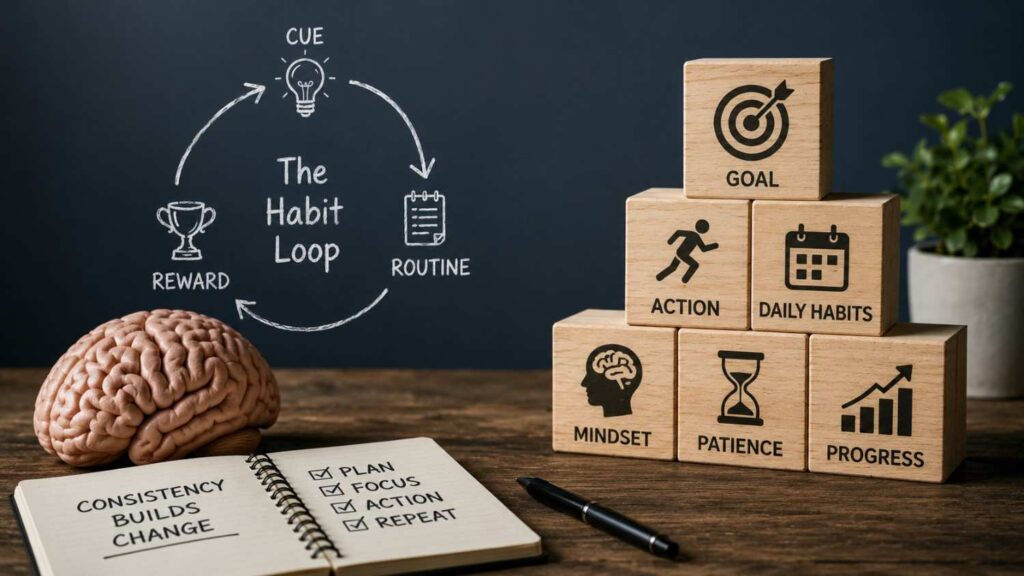
The Science Behind Habit Formation: How Habits Really Work
The science behind habit formation helps explain why some everyday behaviors happen with almost no conscious planning while others require repeated effort. Checking a phone after hearing a notification, preparing coffee after entering the kitchen, or brushing your teeth before bed can eventually feel almost automatic because the surrounding context has become strongly connected with the behavior.
Psychological research suggests that habits are learned responses that develop through repetition in recurring situations. Wendy Wood and Dennis Rünger describe habitual behavior as closely connected to contextual cues and repeated performance. This means that a habit involves more than wanting to do something regularly. The environment, timing, sequence of actions, and repeated behavioral history all influence whether an activity becomes increasingly automatic.
Understanding this process changes the way we approach personal improvement. Motivation can be valuable when starting a new behavior, but motivation naturally fluctuates. Habits can reduce the amount of fresh decision-making required every time an action needs to occur. Instead of repeatedly asking whether to exercise, study, prepare healthy food, or limit digital distractions, a well-established habit can make the preferred response easier to initiate in familiar circumstances.
How Does Habit Formation Actually Work?
Habit formation is best understood as a learning process rather than an instant mental switch. When people begin a new behavior, they usually need to think about what they are doing, remember their intention, and decide whether they are willing to follow through. A new exercise routine, study schedule, meal-preparation practice, or meditation session may initially require deliberate planning because there is not yet a strong learned relationship between the situation and the response.
With repeated performance, that relationship can begin to change. If the same behavior frequently occurs in a similar context, features of the context can become associated with the action. Entering a particular room, finishing breakfast, closing a laptop after work, or hearing an alarm can become part of the situation that helps prompt what happens next. The individual may still have goals and intentions, but the behavior becomes less dependent on starting a completely new decision process every time.
Research on habit formation science also highlights how repeated behaviors become increasingly automatic through consistent practice and contextual cues.
This gradual movement toward automaticity explains why consistency is so important. Successful habit formation does not require every repetition to look identical, but a reasonably stable pattern makes learning easier. The more reliably a desired action follows a recognizable cue, the more opportunities the brain has to strengthen the connection. This process is why specific behavioral plans generally provide a stronger foundation than broad intentions such as “be more productive” or “live healthier.
Table 1: Key Elements of Habit Formation
| Habit Element | What It Involves | Role in Habit Development | Example |
|---|---|---|---|
| Cue | A recurring time, place, object, activity, or situation | Provides a consistent trigger for the behavior | Finishing breakfast |
| Behavior | The specific action performed after the cue | Creates the response that can become habitual | Taking a short walk |
| Repetition | Performing the behavior repeatedly in a similar context | Strengthens the cue-behavior association | Walking after breakfast each day |
| Context | The surrounding situation in which the behavior occurs | Helps the brain associate a situation with a response | Same location or daily routine |
| Automaticity | The behavior becomes easier to initiate with less deliberate thought | Indicates that the behavior is becoming more habitual | Starting the walk without debating it |
| Reinforcement | Outcomes or consequences that support continued behavior | Can encourage repeated performance | Feeling more energized after walking |
Cues Create Associations With Behavior
A habit cue is a feature of the situation that becomes associated with a particular response. Cues can include a time of day, physical location, preceding behavior, object, emotional state, or social situation. For example, finishing breakfast may become associated with taking medication, while sitting at a desk after lunch may become associated with reviewing a daily task list.
The effectiveness of a cue depends partly on its consistency and relevance. A vague plan such as “I will read more often” gives the person few clues about exactly when the behavior should occur. A more specific plan—“After I make my evening tea, I will read ten pages”—connects the behavior with an existing event that is easier to recognize and repeat.
Importantly, a cue does not control behavior in a mechanical or unavoidable way. Instead, repeated pairing makes the behavioral response increasingly accessible when the cue appears. The association develops through learning. Over time, the person may notice that beginning the action requires less internal negotiation because the familiar situation itself helps initiate the response. This is why identifying reliable environmental and behavioral cues is such an important part of practical habit design.
Repetition Gradually Builds Automaticity
Automaticity refers to the extent to which a behavior can be initiated efficiently with relatively little conscious deliberation. It does not mean that people become unconscious or lose control. Instead, the behavior becomes easier to start because the brain does not need to reconstruct the decision from the beginning every time the relevant situation occurs.
The influential study by Phillippa Lally and colleagues illustrates this process clearly. Participants selected an eating, drinking, or activity behavior and attempted to perform it in the same daily context over approximately 12 weeks. Researchers found that automaticity tended to increase gradually. Early repetitions produced noticeable gains, while improvements became smaller as each participant moved closer to a personal plateau.The habit formation process is gradual, with repetition and consistent cues helping behaviors become more automatic over time.
This pattern is important because it shows that habits do not suddenly “switch on” after a particular number of repetitions. Development is progressive. Some behaviors become easier relatively quickly, while others require much more time and repetition. The practical lesson is to focus on maintaining the behavioral pattern rather than waiting for a specific day when the action should supposedly become effortless. Each successful repetition strengthens the conditions under which future automaticity can develop.
Related Articles
What Happens in the Brain When Habits Develop?
The neuroscience of habits is more complex than the popular idea of a single “habit center” in the brain. Habitual behavior involves interactions across multiple neural systems that support learning, action selection, movement, reward processing, and decision-making. Researchers have paid particular attention to networks involving the basal ganglia because these structures contribute to learning repeated patterns of behavior and organizing well-practiced action sequences.
This does not mean that every repeated activity automatically becomes controlled by one isolated neural circuit. Human behavior usually reflects a combination of goals, learned associations, environmental cues, emotional states, and current circumstances. A person may perform a behavior automatically in one setting but think carefully about the same action in another. The balance between habitual and deliberate control can therefore change according to context.
Understanding this complexity is valuable because it prevents oversimplified claims about “rewiring the brain” after a fixed number of days. Neural learning is real, but it develops through repeated experience and interaction with the environment. Habit formation should therefore be understood as a gradual change in how behavior is initiated and organized rather than as a sudden transformation in a single brain region. Research on cortico-basal-ganglia systems provides one important part of that broader explanation.
The Basal Ganglia Help Organize Repeated Actions
The basal ganglia are a group of interconnected brain structures involved in movement, learning, action selection, and the development of repeated behavioral patterns. Neuroscientist Ann Graybiel and other researchers have shown that these systems play an important role in organizing action sequences as they become well practiced. This work has contributed substantially to modern scientific explanations of habitual behavior.
One useful concept is behavioral “chunking.” When an activity is new, a person may need to pay attention to many individual steps. With practice, those steps can become organized into larger, more efficient sequences. Driving provides a familiar example. A beginner consciously monitors steering, pedals, mirrors, speed, and traffic rules, whereas an experienced driver can coordinate many of these actions with far less deliberate attention.
The idea of chunking should not be interpreted as evidence that the brain stops monitoring behavior. Instead, repeated practice changes how familiar sequences are organized and controlled. This allows attention to be used more efficiently and can make routine actions easier to perform. Research on the basal ganglia helps explain the biological foundations of this transition, while behavioral studies show how environmental repetition contributes to the learning process.
Habits and Goals Can Work Together
Popular discussions sometimes describe habits and goals as opposing systems, but real behavior is more nuanced. Goals often help people establish new behaviors in the first place. Someone may consciously decide to improve cardiovascular health, study a language, save money, or sleep more consistently. That goal provides the initial reason for repeatedly performing the desired action.
As repetition continues, the behavior can become increasingly connected with contextual cues. At that stage, the goal has not necessarily disappeared. Instead, a habitual response can help support the larger objective by reducing how often the person needs to make a fresh decision. Someone who values fitness may eventually start preparing for a morning walk almost automatically after getting dressed.
This interaction explains why effective behavior change often involves both intentional planning and habit development. Goals provide direction, while habits can make repeated execution more efficient. Problems arise when established habits conflict with current goals, such as automatically opening social media while intending to focus on work. Understanding both processes allows people to design environments and routines that make beneficial behaviors easier to perform consistently.
How Long Does It Really Take to Form a Habit?
The question “How long does it take to form a habit?” sounds simple, but scientific research does not support one universal answer. Habit development varies considerably because different behaviors place different demands on people. Drinking a glass of water after breakfast is much simpler than completing a demanding workout, preparing an entire healthy meal, or following a complex evening routine every day.
Individual circumstances also matter. People differ in motivation, schedules, physical environments, prior behavior, stress levels, opportunities for repetition, and the consistency of the cues around them. A behavior that fits naturally into one person’s existing routine may require far more planning for another. Researchers therefore study habit formation as a variable process rather than assuming that everyone reaches the same level of automaticity on the same day.
This perspective is important for practical behavior change because fixed deadlines can create unrealistic expectations. If a person believes a habit should feel effortless after 21 or 30 days, continuing difficulty may be interpreted as failure. Scientific evidence suggests a better approach: evaluate whether the action is becoming easier and more automatic over time. Progress matters more than reaching an arbitrary calendar milestone. The goal should be stable repetition and gradually reduced deliberative effort, not satisfying a popular but unsupported deadline.
Why the 21-Day Rule Is Misleading
The popular 21-day habit rule is frequently repeated in self-improvement content, but modern habit research does not support it as a universal scientific law. Habit formation timelines vary widely because behaviors differ in difficulty and because people differ in their circumstances, previous routines, and consistency. A simple daily action can become familiar much faster than a demanding lifestyle change.
In the influential study by Lally and colleagues, participants attempted to repeat a selected behavior in the same daily context. Among participants whose data could be appropriately modeled, estimated time to reach approximately 95% of maximum automaticity ranged from 18 to 254 days. That enormous range directly contradicts the idea that everyone should develop a stable habit within three weeks.
Later research has produced similarly variable results. A randomized trial involving nutrition-related behaviors found a median of 59 days among participants who successfully formed habits, while broader reviews also report substantial differences across studies and target behaviors. The practical conclusion is not that 59 or 66 days should replace 21 as the new magic number. Habit formation does not operate according to a universal countdown.
Missing One Day Does Not Reset Everything
Many habit-building systems place heavy emphasis on maintaining an uninterrupted streak. Tracking consecutive days can be motivating, but scientific research does not suggest that a single missed repetition erases the learning that has already occurred. Habit development is based on accumulated experience rather than a fragile sequence that instantly resets after one lapse.
In Lally and colleagues’ study, missing one opportunity to perform the chosen behavior did not materially disrupt the overall habit-formation process. This finding is useful because real life inevitably includes travel, illness, emergencies, schedule changes, and days when motivation is unusually low. Expecting perfection can make a normal interruption feel more serious than it actually is.
A more productive response is to return to the behavior when the next appropriate cue appears. If you miss one morning walk, continue the following day. If you skip one planned reading session, resume after the next usual cue. This approach keeps attention on the long-term pattern rather than treating a temporary lapse as evidence of failure. Consistency remains important, but resilience after interruptions is part of sustainable habit development.
Why Are Bad Habits So Difficult to Break?
Unwanted habits are difficult to change because deciding that a behavior is no longer useful does not automatically erase the learned relationship between the behavior and its usual cues. A person can genuinely intend to stop checking a phone during work, eating snacks late at night, or procrastinating before an important task while still finding the familiar response surprisingly easy to repeat.
This apparent contradiction becomes easier to understand when habits are viewed as context-linked behavior. If the surrounding situation remains unchanged, many of the same cues that supported the old response are still present. Sitting on the sofa may prompt snacking, opening a laptop may trigger email checking, or feeling bored may prompt social-media use. The environment continues to provide reminders of the established behavioral pattern.
Effective habit change therefore requires more than strong intentions. It often helps to examine when, where, and under what circumstances the behavior occurs. Changing those conditions can reduce the strength of familiar triggers or create opportunities for a different response. This does not guarantee instant change, particularly when the habit is strong, but it shifts attention from blaming willpower to modifying the behavioral environment. Research on context disruption provides an important scientific basis for this approach.
Table 2: Common Habit Triggers and Practical Changes
| Habit Challenge | Common Trigger or Context | What Keeps the Pattern Going | Practical Environmental Change | Replacement Approach |
|---|---|---|---|---|
| Automatic snacking | Watching television | Food is easily available in the same context | Keep tempting snacks out of immediate reach | Prepare a healthier snack before watching |
| Frequent social-media checking | Phone beside the workspace | The familiar phone location acts as a cue | Keep the phone away from the desk | Use a planned work-break activity instead |
| Skipping exercise | Returning home after work | Fatigue and an established evening context | Keep walking shoes visible and ready | Start with a short 10–15 minute walk |
| Unplanned phone use at bedtime | Phone beside the bed | Familiar location triggers checking | Place the phone outside the bedroom | Replace checking with a consistent bedtime activity |
| Delaying study sessions | Sitting down without a defined task | Lack of a specific cue or action | Prepare the study materials beforehand | Start with one clearly defined study task |
| Returning to an unwanted behavior | Familiar people, places, or situations | Stable contextual cues can reactivate old responses | Change or interrupt the triggering context | Use an “if-then” plan for the alternative response |
Familiar Contexts Keep Triggering Old Responses
Context plays a central role in habitual behavior because the same surroundings often accompany the same actions repeatedly. Over time, features of those surroundings can become linked with the response. This helps explain why an unwanted behavior may feel manageable while traveling or working somewhere new but return quickly after a person goes back to a familiar routine.
Research by Wendy Wood and colleagues examined behavioral changes among students whose environments were changing. Established behaviors were more likely to be disrupted when important aspects of their normal performance context also changed. When the relevant circumstances remained stable, existing patterns were more likely to continue, even when intentions pointed in a different direction.
The practical implication is that changing cues can make behavior change easier. If you automatically snack while watching television, storing snack foods outside the room changes part of the normal context. If your phone constantly interrupts focused work, placing it in another room removes a prominent cue. Environmental change does not eliminate responsibility, but it can reduce unnecessary exposure to triggers that repeatedly activate an unwanted response.
Replacement Can Be More Practical Than Suppression
Trying to stop a behavior without deciding what to do instead can leave a gap in the original situation. The familiar trigger still appears, but the person has no clearly prepared alternative response. This is why simply repeating “I will not check my phone” or “I will stop snacking” can be less useful than creating a specific replacement behavior.
Implementation intentions provide one structured method for preparing an alternative. These plans typically follow an “if X happens, then I will do Y” format. For example, “If I feel like checking social media while writing, I will make a note of the urge and continue working for five more minutes.” The plan links a known trigger with a chosen response.
Research suggests that counter-habitual implementation intentions can help people act differently when familiar cues occur, although effectiveness depends on the behavior, situation, and strength of the competing goal. Replacement should therefore be realistic and easy to perform. The goal is not to fight every urge through constant mental effort, but to establish another response that can gradually become more available in the same situation.
How Can You Build Better Habits Using Science?
Building better habits starts with designing behaviors that can be repeated consistently enough for learning to occur. Large goals such as “become healthier,” “be more productive,” or “save more money” may provide motivation, but they do not specify what should happen in a particular moment. Habit formation becomes easier to work with when an abstract goal is converted into a specific, observable action.
The next step is to connect that action with a reliable context. A person might stretch after brushing their teeth, review tomorrow’s priorities after closing work applications, or drink water after making morning coffee. These pairings are useful because the cue already exists. Rather than remembering the new behavior at random moments, the individual attaches it to an event that occurs regularly.
Finally, the behavior needs to remain manageable enough to repeat. Beginning with an ambitious routine may feel motivating, but complexity can create friction. A smaller action performed consistently gives the person more opportunities to strengthen the cue-response relationship. As the behavior becomes easier and more stable, it can be expanded. The science behind habit formation therefore favors clear behaviors, reliable cues, repeated performance, and supportive environments over dramatic short-term intensity.
Use This Five-Step Habit-Building Process
A practical habit-building process begins by defining one behavior precisely. “Exercise more” is difficult to execute because it leaves many decisions unresolved. “Walk for ten minutes after lunch on weekdays” is more useful because the behavior, duration, and cue are clear. Specificity reduces the amount of planning required when it is time to act.
Second, choose a cue that occurs reliably and make the first version of the behavior easy enough to repeat. Third, perform the action when that cue appears as consistently as possible. Fourth, return to the behavior after occasional interruptions instead of treating one missed day as failure. These steps create repeated opportunities for the desired cue-response relationship to strengthen.
Fifth, track more than streak length. Notice whether the behavior feels easier to remember and initiate. Ask whether you begin acting with less internal debate or whether the cue increasingly reminds you of the behavior automatically. Studies comparing routine-based and time-based cues show that both approaches can support habit development when people successfully perform the behavior repeatedly in response to their selected cue.
Design the Environment Instead of Relying Only on Willpower
Willpower can help people make difficult choices, but relying on it as the only behavior-change strategy ignores the influence of the environment. Everyday surroundings constantly shape what is visible, convenient, and easy to start. A useful object placed in sight can encourage a behavior, while a distracting object within immediate reach can make an unwanted response more likely.
Environmental design works by changing the friction surrounding different actions. Leaving running shoes beside the door reduces preparation before a walk. Keeping healthy food visible may make it easier to choose. Moving social-media applications away from the phone’s main screen introduces an extra step before opening them. These changes are small, but repeated situations make small differences meaningful.
Research showing that context changes can disrupt established habits helps explain why environmental design is useful. The strategy does not eliminate personal choice. Instead, it changes the circumstances in which choices occur. When desirable behaviors are easier to start and unwanted ones require more effort, the environment supports the intended goal rather than repeatedly competing with it. This is often more sustainable than expecting constant conscious resistance.
Quick Answer About The Science Behind Habit Formation
The science behind habit formation shows that habits develop through repeated interactions between behavior and context. When a person performs the same action in response to a recurring cue, the connection between that situation and the behavior can gradually strengthen. Over time, beginning the action may require less conscious deliberation. Researchers commonly refer to this growing ease of initiation as automaticity, and it is one of the most important concepts in modern habit research.
This process helps explain why habits are different from simple routines. A routine can be performed repeatedly while still requiring planning or reminders. A stronger habit is increasingly triggered by familiar circumstances, such as a location, time of day, preceding action, or object in the environment. The behavioral response becomes more readily available when the relevant cue appears, which can make everyday actions feel easier to start.
Scientific evidence also shows that there is no universal number of days required to create a habit. In a widely cited real-world study, estimated time to approach maximum automaticity varied from 18 to 254 days. Individual differences, behavior complexity, consistency, and context all influence the process. Missing one opportunity did not destroy participants’ progress, suggesting that sustained repetition matters more than maintaining a perfect streak.
Habit Formation in One Sentence
Habit formation is the gradual learning process through which repeating an action in a recurring context makes that action increasingly likely to occur with less conscious deliberation. The key idea is not simply that a person performs something frequently. Instead, the surrounding situation becomes associated with the response, allowing the context itself to help prompt future behavior.
This distinction explains why two people can perform the same action equally often without developing equally strong habits. One person may perform it in a consistent situation, while another does it at unpredictable times and places. The stable context provides more reliable opportunities for a cue-response relationship to develop, which can support stronger automaticity over time.
Research on habit automaticity therefore focuses on more than frequency alone. Scientists examine how behaviors are initiated, whether they feel mentally effortful, and how strongly they are connected to contextual cues. This framework provides a more precise explanation of habitual behavior than simply describing a habit as “something you do every day.
The Most Important Practical Principle
The most practical lesson from habit research is to make a desired behavior easy to repeat in response to a clear and reliable cue. Instead of depending on a vague intention such as “I should exercise more,” it is generally more useful to specify what action will occur and the situation in which it will happen.
For example, “I will walk for 15 minutes after dinner” creates a clearer behavioral structure than “I will become more active.” Dinner serves as a predictable event, and walking becomes the planned response. Each time the sequence is successfully repeated, the person has another opportunity to strengthen the relationship between that cue and the desired action.
Research comparing different cue-planning strategies supports the importance of repeatedly performing planned behavior when the selected cue occurs. The goal is not to create a magical trigger after only a few repetitions. It is to provide a stable learning environment in which automaticity can develop gradually. Consistent cue-behavior enactment is therefore more useful than relying entirely on motivation or waiting to feel inspired.
Frequently Asked Questions About The Science Behind Habit Formation
Habit formation is surrounded by popular rules, motivational slogans, and simplified advice, so readers often encounter conflicting explanations. Some sources claim that every habit takes a fixed number of days, while others suggest that missing a single repetition destroys progress. Scientific research presents a more flexible and realistic picture in which automaticity develops gradually and at different speeds.
Another common source of confusion is the difference between repetition and habit. Doing something repeatedly is important, but frequency alone does not fully define habitual behavior. Researchers are also interested in how strongly the behavior is connected with cues, how automatically it begins, and how much conscious effort is required to initiate it. These distinctions help explain why some daily routines remain effortful while other actions become almost effortless.
The following questions address the most important misconceptions and practical concerns using the scientific framework described throughout this article. The answers focus on habit automaticity, environmental context, lapses, routines, and the timelines reported in research. Together, they provide a concise summary for readers who want evidence-based guidance without relying on rigid rules or unsupported claims about instant behavioral transformation.
Does It Really Take 21 Days to Form a Habit?
No. Scientific research does not support 21 days as a universal period for habit formation. Different behaviors require different amounts of learning, and individuals vary in their schedules, environments, motivation, and consistency. A very simple behavior performed in a stable context may become familiar relatively quickly, while a difficult lifestyle change can take considerably longer.
The Lally study provides one of the clearest demonstrations of this variation. Estimated time to reach approximately 95% of maximum automaticity ranged from 18 to 254 days among participants whose habit-development data could be modeled. This range shows why one number cannot describe everyone.
Instead of using 21 days as a deadline, it is more useful to monitor whether the behavior is becoming easier to initiate over time. Continued repetition in a reliable context matters more than completing a specific number of calendar days.
Is 66 Days the Correct Habit-Formation Number?
The frequently repeated figure of 66 days is more closely connected with research than the 21-day claim, but it is still often misunderstood. It represents a summary value from one influential study rather than a universal biological threshold after which every behavior automatically becomes habitual.
Participants in the study differed substantially. Some behaviors developed relatively quickly, while others required many months to approach their estimated automaticity plateau. The wide 18-to-254-day range is more informative than treating 66 days as a guaranteed deadline.
For practical purposes, the 66-day figure can remind people that habit formation often takes longer than a few weeks. However, it should not become another rigid rule. A better measure is whether the desired behavior is becoming easier to remember, initiate, and repeat in the context in which it is supposed to occur.
What Is the Most Important Part of Building a Habit?
One of the most important principles is repeatedly performing a clearly defined behavior in response to a reliable cue. A specific cue reduces ambiguity about when the behavior should occur, while repetition creates opportunities for the relationship between the context and response to strengthen.
The behavior also needs to be realistic enough to perform regularly. A plan that is too difficult may produce fewer successful repetitions, even if it sounds ambitious. Starting with a manageable version can make it easier to establish the pattern before increasing difficulty, duration, or complexity.
Research comparing routine-based and time-based cues suggests that different types of cues can support habit development when people successfully enact their planned behavior. The key is not choosing one universally perfect cue. It is selecting a cue that is predictable within your own life and consistently following it with the intended action.
Can You Break a Bad Habit Completely?
Unwanted habits can become weaker and less influential, but changing them is often more complicated than simply deciding to stop. Familiar contexts may continue to make old responses accessible, especially when the person encounters the same locations, emotional states, objects, or sequences that previously accompanied the behavior.
This is why modifying cues can be useful. Changing where an object is stored, adjusting the sequence of a routine, or creating distance from a common trigger can interrupt the conditions that normally support the unwanted response. The environment becomes less effective at prompting the old behavior automatically.
People can also create alternative responses for situations in which the cue cannot be removed. Over time, consistently performing the preferred response can help establish a new behavioral pattern. The most realistic goal is often not to erase the past completely, but to reduce how strongly old cues control current behavior.
Does Missing a Day Destroy a New Habit?
Missing one day does not automatically destroy a developing habit. Habit formation reflects the accumulated history of repeating a behavior in a recurring context. One interruption does not erase every previous repetition or instantly eliminate the associations that have already begun to develop.
Lally and colleagues specifically reported that missing one opportunity did not materially affect the habit-development process in their study. This provides a useful counterpoint to habit systems that treat an uninterrupted streak as the only meaningful measure of progress.
The better response to a lapse is to resume the behavior at the next suitable opportunity. A missed day becomes more problematic when it turns into a long-term abandonment of the pattern. Treating normal interruptions calmly can therefore support persistence and prevent an unnecessary “I failed, so I may as well quit” reaction.
Are Habits the Same as Routines?
Habits and routines overlap, but they are not necessarily identical. A routine is a behavior or sequence performed regularly. However, the person may still need to consciously remember, plan, or motivate themselves to perform it each time. Frequency alone does not guarantee strong automaticity.
A habit places greater emphasis on the relationship between contextual cues and the response. As the association becomes stronger, encountering the relevant situation can make the behavior easier to begin without extensive conscious deliberation. This automaticity is an important concept in psychological research.
For example, someone may follow a weekly budgeting routine but still need to schedule and deliberately start it every Sunday. In contrast, automatically locking the door after leaving home may require very little conscious planning. Both behaviors can be repeated regularly, but the second example may demonstrate stronger cue-contingent automaticity.
Conclusion
The central lesson from modern habit research is that lasting behavior change depends less on discovering a perfect number of days and more on creating conditions that support reliable repetition. Habits develop gradually as behaviors are repeatedly performed in recurring contexts. Over time, relevant cues can become increasingly effective at prompting the response, reducing the amount of conscious effort required to begin.
This scientific model provides a more realistic alternative to advice based entirely on motivation or willpower. Motivation can help start the process, but motivation naturally rises and falls. Stable cues, manageable actions, environmental design, and repeated enactment make it easier to continue even on days when enthusiasm is limited. Occasional lapses also do not mean that all progress has disappeared.
For readers interested in personal development, the most useful approach is therefore practical rather than dramatic. Choose a clear behavior, connect it with a reliable cue, make the first version achievable, repeat it consistently, and adjust the environment so that the desired action is easier to perform. Whether the goal involves exercise, learning, nutrition, productivity, or digital behavior, the same underlying principles of repetition, context, and automaticity provide a scientifically grounded framework for building sustainable patterns.
What The Science Behind Habit Formation Tells Us
The science behind habit formation shows that habits emerge from learned relationships between situations and responses. Repetition matters because each successful performance in a similar context provides another opportunity for the cue and behavior to become associated. As that relationship strengthens, initiating the behavior can require less active decision-making.
Neuroscience adds another layer to this explanation. Research involving cortico-basal-ganglia systems suggests that repeated action sequences can become organized more efficiently through learning. This does not mean that habits are stored in one isolated “habit center.” Instead, multiple neural systems contribute to how familiar behaviors are selected and performed.
Behavioral research also demonstrates substantial variation. Different people and behaviors can require very different amounts of time before automaticity approaches a plateau. The evidence therefore supports flexibility rather than rigid deadlines. Understanding these mechanisms allows people to design habit strategies around learning, context, and repetition rather than relying on oversimplified claims about instant transformation.
The Practical Takeaway
The practical strategy for building a good habit is straightforward: define the behavior, identify a reliable cue, make the first version manageable, and repeat the action when the cue occurs. Instead of focusing entirely on how motivated you feel, focus on whether your environment makes the preferred response easy to remember and start.
Changing unwanted habits requires a similar analysis. Identify the situations that normally trigger the behavior, then decide whether those cues can be removed, reduced, or modified. When a trigger cannot be avoided, prepare a specific replacement response so that you are not relying on suppression alone.
Most importantly, think in terms of patterns rather than perfection. One missed repetition does not erase previous learning. Resume the behavior when the next relevant cue appears and continue strengthening the association. This approach may be less exciting than a promise of complete transformation in 21 days, but it is far more consistent with the evidence behind sustainable behavior change.